There is no trick that wins every game of Ludo. The dice see to that. What tips and tricks can do is make sure you waste fewer rolls than everyone else at the table, and over a few games that adds up to a lot more wins.
Here are fifteen, in the order a game happens. If you want the reasoning and the test results behind the most important ones, read how to win at Ludo.
Opening: the first few sixes
1. Get a second piece out early. One piece on the board means every roll moves that piece, good or bad. Two pieces give you a choice on every roll, and choice is the only thing you control in Ludo.
2. Don't empty your base in a hurry, either. Four pieces sitting just outside base are four targets. Bring pieces out when a 6 has nothing better to do, not as a reflex.
3. Use the start square. In classic Ludo your start square is safe, so a piece that has just come out can wait there while you move others. Check your house rules, because not every family plays it that way.
4. Learn where the safe squares are. On a standard board there are eight: the four start squares and four stars, spaced 8, then 5, then 8, then 5 squares apart round the track. Knowing the gaps lets you plan hops from one to the next. Ludo safe squares explained has the full map.
Middle game: staying alive
5. Count six squares behind you. Any enemy from one to six squares behind a piece can land on it with a single roll. Before you move, look at where each of your pieces will end up and count back six. If you can stop somewhere nobody can reach, do it.
6. Park just ahead of danger, not just behind it. Sitting right behind an enemy feels aggressive, but the threat is the other way round: the piece behind is the one that can hit. Being one to six squares in front of an enemy is exactly where you don't want to be.
7. Capture when it's cheap. A capture sends a piece back to its base, which costs the other player a lot of progress, and many house rules give you an extra roll for it. Take captures that don't leave your own piece stranded in front of two enemies.
8. Hunt the pieces that have come furthest. Knocking out a piece that is nearly home costs its owner almost a full lap. Knocking out one that just left base costs very little.
9. Don't run one piece all the way home alone. It's tempting to get a piece safe in the home lane, but while it runs, your other pieces sit in base doing nothing. Spread your moves so you always have options.
Endgame: the race home
10. Get into the home lane, then relax. Once a piece is in its own coloured home lane no one can capture it. Use your awkward rolls on pieces already in the lane only when nothing else on the board is in danger.
11. Plan for the exact roll. If your house rules need an exact roll to reach home, a piece two squares from the end can only finish on a 2. Keep another piece moving so a 5 or a 6 isn't wasted.
12. Remember the three-sixes rule. In many games three sixes in a row ends your turn and can cancel your moves. If you've rolled two sixes, make the second move a safe one. What happens when you roll three sixes explains the variations.
At the table
13. Agree the rules before the first roll. Need a 6 to leave base? Extra turn for a capture? Exact roll home? Most Ludo arguments are really two sets of house rules colliding. Decide first, or use an app that fixes the rules for everyone. Our list of the best Ludo house rules shows which ones change the game the most.
14. Fewer pieces means a faster, sharper game. If you're short of time, play with two pieces each instead of four. The game gets shorter and every decision matters more.
15. Practise against a computer that doesn't get tired. A computer opponent plays the same way every time, so it's a good place to test a habit. In Ludo Fighters you can choose a Lumi AI personality, from Rookie up to Commander, and our guide to beating the computer in Ludo explains what each one does.
Tricks for battle Ludo
If you play Ludo Fighters, the same tips work, with a few extras:
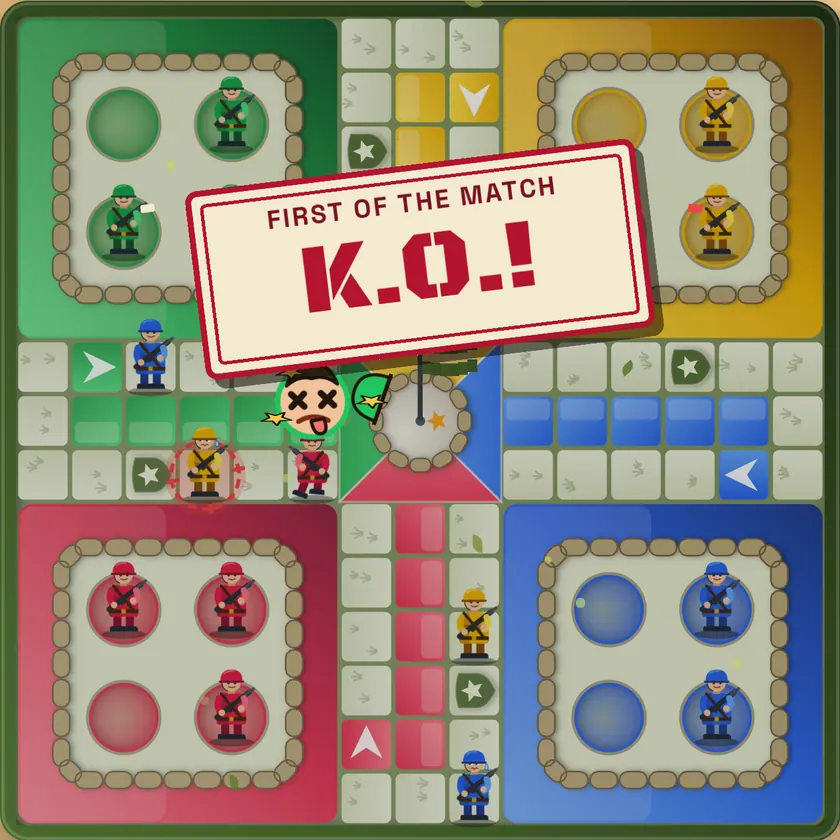
- Shields are your cover. The safe stars and start squares carry a shield, and a shot at a soldier there just ricochets. Treat them as the only real cover on the board.
- A won fight is a second roll. By default, winning a gun fight earns another turn, so one good capture can set up the next.
- Read the mines. With Landmines on, any enemy who ends a move on your hidden mine goes back to base, but passing over it does nothing. Lay mines on squares enemies are likely to stop on, like the square just in front of a shield. Ludo with landmines has more.
Common questions
Is there a trick to win Ludo every time?
No. The dice are random, so nobody wins every game. Good habits, like keeping pieces out of reach of enemies behind them and using the safe squares, make you win more often over many games.
What is the best Ludo strategy for beginners?
Keep two pieces in play so you always have a choice, count six squares behind each piece before you move, and use the safe squares as stepping stones. Those three habits fix most beginner mistakes.
Should I always capture when I can?
Usually, but not when it leaves your piece sitting just in front of several enemies. A capture that gets your own piece knocked out next turn often isn't worth it.
Does the colour you pick matter in Ludo?
Not in a standard game: every colour has the same track length and the same number of safe squares. In a two-player game, where you sit relative to your opponent matters more than the colour, as our guide to Ludo rules for 2 players explains.