Ludo rulesEvery rule of Ludo. No arguments.
The complete classic Ludo rules, from setting up the board to the last piece home, plus the house rules families argue about and what Ludo Fighters changes. Read it once and settle every table dispute.
In sixty seconds
Ludo, in one paragraph
Each player has four pieces in a coloured yard. Roll a 6 to bring a piece out, then move it clockwise by the number you roll. Land exactly on an opponent to send it back to its yard, unless it sits on a safe square. After one lap, turn into your own home column and reach the centre with an exact roll. Get all four pieces home first and you win.
That is the whole game. Everything else on this page is detail: what to do when you cannot move, which squares are safe, and the house rules that change from one family to the next.
- players, one colour each
- 2–4
- players, one colour each
- pieces per player
- 4
- pieces per player
- squares around the track
- 52
- squares around the track
- squares in each home column
- 5
- squares in each home column
- safe squares on the board
- 8
- safe squares on the board
- the number that opens the game
- 6
- the number that opens the game
The board
Know the ground before you roll
A Ludo board is a 15 by 15 grid shaped like a plus sign, with a large yard in each corner.
Yards
The four corner squares, one per colour. Each holds that player's four pieces at the start of the game.
Start squares
The coloured square just outside each yard, where a piece enters the track. It is also a safe square.
The track
Fifty-two squares running around the arms of the cross. Every colour shares it, which is where captures happen.
Home columns
A coloured lane of five squares leading from the track to the centre. Only that colour may enter it.
Home
The centre triangle in each colour. A piece that arrives here is finished and off the board for good.
The classic rules
Ten rules, start to finish
These are the Ludo rules most families learned, in the order they come up in a game. Where tables commonly disagree, it is noted.
- 01
Decide who starts
Every player rolls once. The highest roll goes first, and play then passes clockwise around the table, one turn each.
- 02
Roll a 6 to bring a piece out
All pieces begin in their yard. A piece can only enter the track on a roll of 6, and it is placed on that colour's start square.
- 03
Move by the number you roll
Move one piece forward exactly as many squares as the die shows, clockwise around the track. You cannot split a roll between two pieces.
- 04
A 6 earns another roll
Roll a 6 and you take your move, then roll again. You may use a 6 to bring out a new piece or to move one already on the track.
- 05
Three 6s in a row ends the turn
In most rule sets a third 6 in a row cancels your turn, so a lucky streak cannot run away with the game.
- 06
Land on an opponent to capture it
Finish your move exactly on a square held by an opponent's piece and that piece is sent back to its yard. It needs another 6 to come out again.
- 07
Safe squares cannot be captured on
Start squares and the star squares are safe. Pieces of different colours can share them and nobody is sent home.
- 08
Enter your home column
After a full lap a piece turns off the track into its own coloured home column. Opponents cannot enter it, so pieces there are safe.
- 09
Reach home with an exact roll
A piece must land exactly on the home square. If the roll is too high, that piece cannot move and you must move another or pass.
- 10
Get all four pieces home to win
The first player to bring all four pieces into home wins. Others can keep playing for second, third and fourth place.
No legal move? If no piece can use the roll, for example every piece is in the yard and you did not roll a 6, your turn simply passes.
Captures
When a piece goes back to the yard
Captures are what make Ludo a fight rather than a race. Three situations cover every case.
Exact landing captures
Your move ends on an opponent's square: that piece returns to its yard.
Safe squares protect
The same move onto a start or star square captures nothing. Both pieces share it.
Passing over is harmless
Only the final square counts. Jumping over an opponent leaves it where it is.
The finish
The last five squares are the hardest
Once a piece is in its home column it is out of danger, but it still needs the right number to get in.
- A piece turns into its home column after one full lap. It never goes round a second time.
- Three squares from home? Only a 3 brings that piece in. A bigger roll must be used by another piece, or the turn passes.
- The winner is the first player with all four pieces home. A faster variant ends the game when the first single piece arrives.
House rules
The variants every family plays differently
Ludo has no single governing body, so rules drift from home to home. Here are the common variants, what they mean, and how each one works in Ludo Fighters.
| Variant | What it means | In Ludo Fighters |
|---|---|---|
| Need a 6 to enter | Pieces leave the yard only on a 6. | On by default, can be switched off |
| Extra roll on a 6 | Rolling a 6 gives another roll. | On by default, can be switched off |
| Extra roll on a capture | Capturing an opponent earns a bonus roll. | Winning a gun fight earns one; switchable |
| Extra roll for reaching home | Getting a piece home earns a bonus roll. | Available as a switch |
| Three 6s forfeit | A third 6 in a row ends the turn. | On by default, can be switched off |
| Exact roll to finish | Pieces must land exactly on home. | On by default, can be switched off |
| Safe squares | Start and star squares cannot be captured on. | Eight shielded squares |
| First piece home wins | A short game: the first piece home wins. | Choose All 4 home or First home |
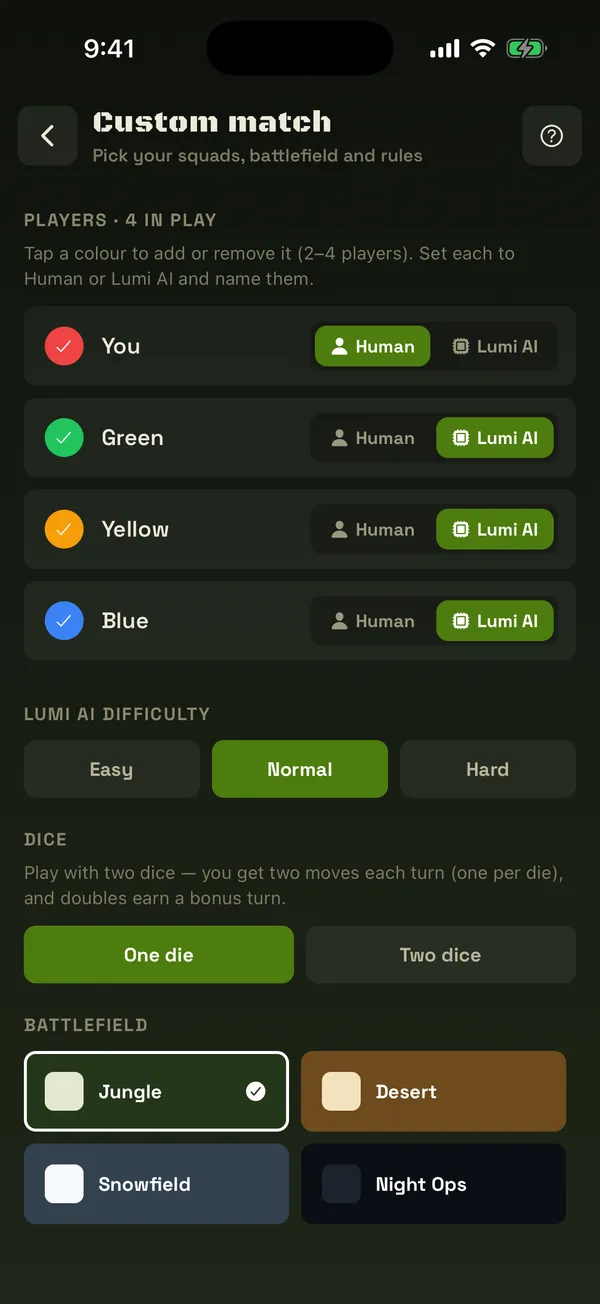
| Two dice | Roll two dice and make two moves. | One die or two dice; doubles give a bonus turn |
| Blocks (barriers) | Two same-colour pieces on one square cannot be passed. | Not part of Ludo Fighters |
Every switch above lives in Custom match. See all the defaults on the game modes and house rules page.
Ludo Fighters
Same rules. One big change.
Ludo Fighters keeps the classic Ludo rules above. What changes is what a capture looks and sounds like, and how much of the rulebook you control.
A capture is a gun fight
Your soldier stops one square short and opens fire with a pistol, rifle, shotgun, sniper or grenade. The enemy is knocked out, vanishes in smoke and respawns at its base.
Safe stars carry a shield
Fire at a soldier on a safe star and the shot ricochets off a blue dome. Nobody goes home.
One die or two
Play classic single-die Ludo, or roll two dice and make two moves a turn. Doubles give a bonus turn.
Seats for anyone
Each colour can be a human, Lumi AI or switched off, so two, three or four can play on one phone.
Ludo rules FAQ
The questions that start arguments
Short answers to the rules people check most often.
Do you need a 6 to start in Ludo?+
How many players can play Ludo?+
What happens if you roll three 6s in a row?+
Can you capture a piece on a safe square?+
Do you need an exact roll to get home in Ludo?+
What is a block in Ludo?+
Who goes first in Ludo?+
Know the rules? Now bring the fire.
Ludo Fighters plays by the rules on this page, with a gun fight on every capture. It is coming soon to Google Play and the App Store.