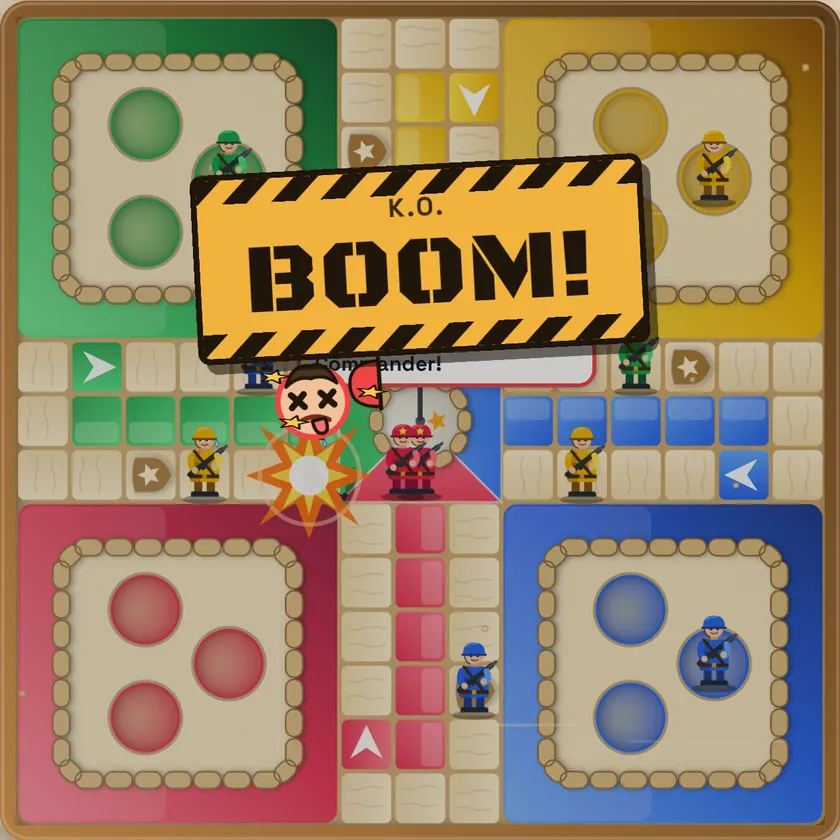
Ludo with landmines and killstreaks is what you get when you switch on two of the optional rules in Ludo Fighters. Mines reward patience: you hide a trap and wait. Killstreaks reward aggression: you chain captures and earn a Radar Lock, then an Airstrike. This guide covers both.
In Ludo Fighters, a landmine is a hidden trap you lay on the track. Every soldier who gets home earns you one, and any enemy who ends a move exactly on it goes back to base. Walking over a mine does nothing. The rule is optional and off until you switch it on.
Classic Ludo has no mines, so this is a Ludo Fighters rule rather than a traditional one. It changes the game because it gives you something to do with a soldier who has already finished.
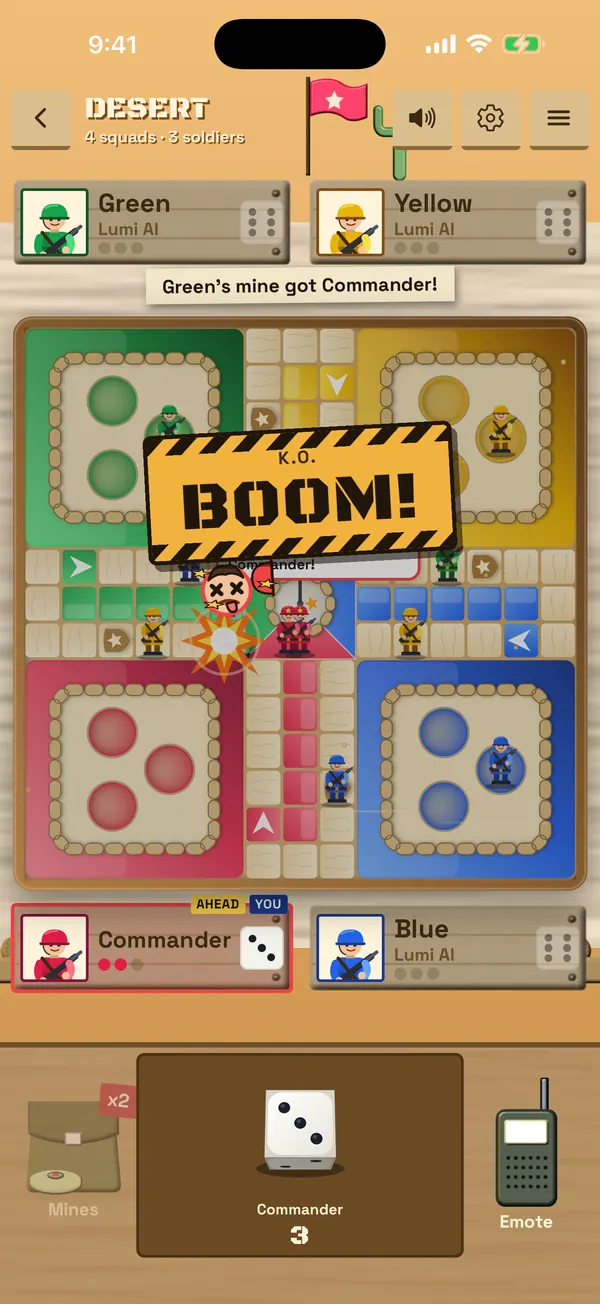
The rules in one table
| Question | Answer |
|---|---|
| How do I earn a mine? | One for each soldier who gets home, as long as your squad still has soldiers out |
| When can I lay it? | On your turn, before you roll |
| Where can it go? | Any open square on the shared track |
| Where can't it go? | A safe star, any start square, a square with a soldier on it, or one of your own mines |
| What sets it off? | An enemy ending a move exactly on that square |
| What happens? | The soldier goes back to base and the mine is used up |
| Who can see it? | Only you |
The last soldier to finish your squad earns nothing, because the match is over for you at that point. In a one-soldier match there are no mines to earn at all, unless a crate gives you one.
What counts as stepping on it
Only the end of a move counts. A soldier who walks across your mine on the way somewhere else is fine. That matters for placement: you are not guarding a stretch of road, you are betting on one exact landing.
Your own mines never go off under you. In Squad Wars your partner's mines don't either. If two enemy squads have mines on the same square, they all go off together.
How likely is a hit?
A soldier with one die can only land on the six squares ahead of it, and each number comes up one time in six. So a mine one to six squares ahead of a single enemy soldier has a 1 in 6 chance, 16.7%, of being the exact landing on the next roll. Anything seven or more squares ahead can't be hit by that roll at all.
The chance only comes good if the player moves that soldier, and they usually have a choice. A mine works best when moving that soldier is the obvious play.
On a four-house board there are 52 squares on the track and 8 are safe or start squares, so 44 can hold a mine. On a six-house board there are 78 squares and 12 are off limits, so 66 can.
Where to put a mine
On the far side of a shield star. Players love hopping from safe square to safe square. A soldier leaving a star is usually going forward into the open, so the squares just past it see a lot of traffic.
In the long gap. Safe squares alternate 8 apart and 5 apart, as the safe squares guide explains. The eight-square stretch is where a soldier has to stop in the open at least once. A mine there is hard to route around.
Ahead of the leader. A soldier close to home is the most expensive thing on the board. Put a mine in front of it on the last stretch before its home lane and every small roll becomes a risk. Home lanes themselves are safe, so it has to be on the shared track.
Where the die will force it. If an enemy has only one soldier out, every roll has to move that soldier. A mine within six squares of a lone runner is close to a free 1 in 6.
Not where you are about to walk. Your own mine won't hurt you, but it also won't stop an enemy who is standing behind you with a different number. Don't spend one where a shield would have done the job.
The Mine detector
If the match also has the Mine detector rule, each squad starts with one sweep. Use it before you roll and it shows enemy mines just ahead of your soldiers, within six squares, to you only. It needs Landmines to be on.
Save it for the moment a soldier is about to run the last stretch. Crates from Supply drops can add another charge. In Pass & play a curtain covers the board so nobody else sees your reading.
Other ways out
- A combat shield from a Supply drop takes the blast for the soldier carrying it.
- The Sappers Chaos card clears every mine on the board.
- A mine that has gone off is gone, so a sacrificed soldier can clear the road for a more valuable one.
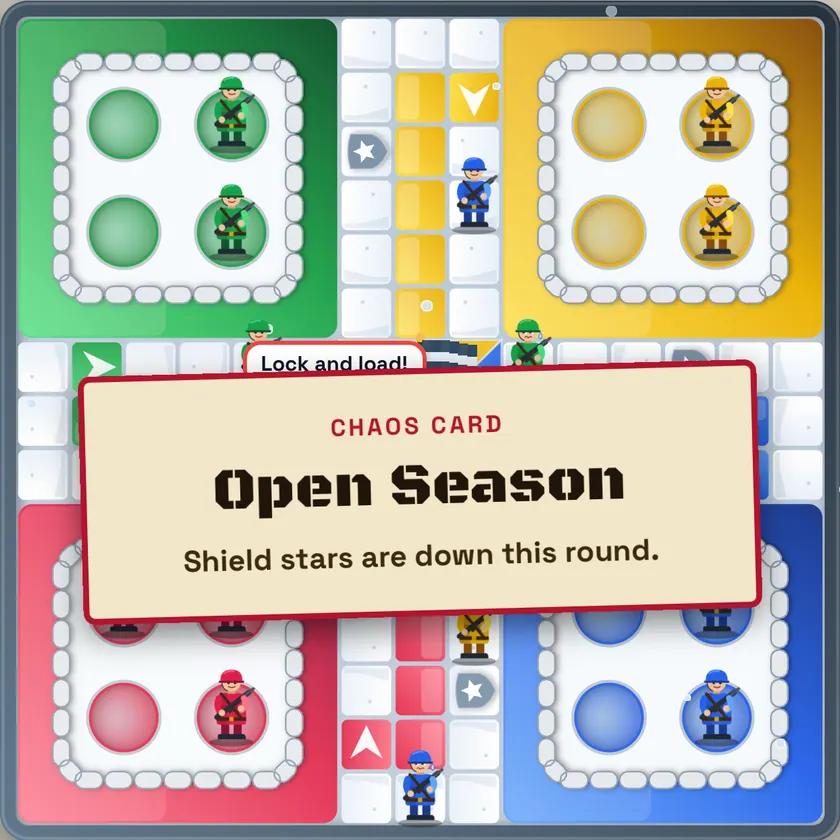
Killstreaks, Radar Lock and Airstrike
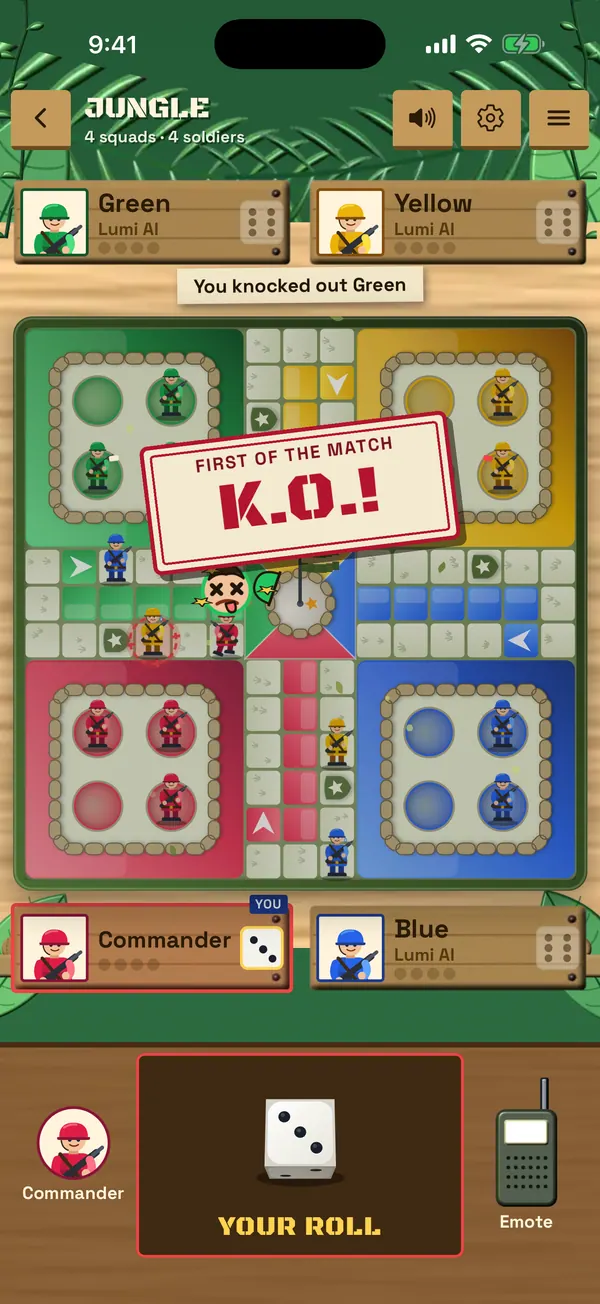
Killstreaks are the attacking half of the extras. Capture without losing a soldier and you build a streak. Lose a soldier and the count goes back to nothing.
| Streak | What you earn | What it does |
|---|---|---|
| 2 captures in a row | Radar Lock | Throws the dice again |
| 3 captures in a row | Airstrike | Mark a square, and at the start of your next turn it comes down on that square and its two neighbours |
Shield stars and start squares are never hit by an Airstrike, and everyone can see the marked square, so a smart rival will walk out of the way. That is the point of it: an Airstrike moves people as often as it knocks them out. In Squad Wars, partners are safe from each other's strikes.
When to spend a Radar Lock
A Radar Lock is a second throw of the dice, so keep it for the roll that decides something. The best moments are a bad number with a soldier in danger, a missed exact landing on an enemy, or the last few squares to home when you need one particular number.
Where to call an Airstrike
Aim for the square with the most enemy soldiers around it, and think about where they will still be after their own turn. A soldier about to leave for the home lane is a poor target, because the home lane is out of reach. A soldier stuck behind a long gap with nothing close to play is a good one.
Landmines and killstreaks together
The two rules feed each other. A mine knocks a soldier out without spending your move, and that can clear the way for the capture that keeps your streak going. Pair them in Match Builder, or use the Total Chaos preset, which switches on every extra at once.
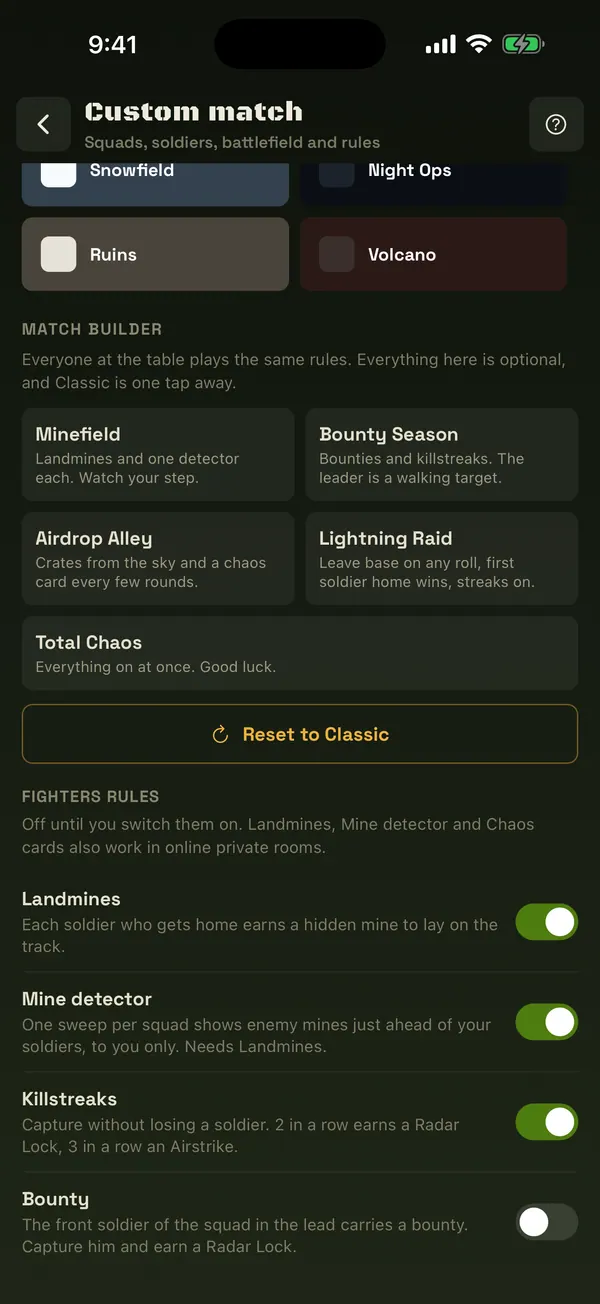
How to switch them on
Open Custom match or Pass & play, go to Match Builder and turn on Landmines or Killstreaks. The Minefield preset gives you Landmines plus one detector each, and Bounty Season gives you Bounty plus Killstreaks. In Online squads, the host of a private room can switch on Landmines, but Killstreaks stay offline, and Quick battle is always Classic.
The full set of switches is in how to build your own Ludo rules.
Common questions
Is there a Ludo game with landmines and killstreaks?
Yes. Ludo Fighters has both as optional rules, off until you switch them on in Match Builder. Classic Ludo has neither.
Do killstreaks work online?
No. Killstreaks are offline only, in Custom match and Pass & play. Online private rooms can run Landmines, Mine detector and Chaos cards.
What does a killstreak give you?
Two captures in a row without losing a soldier earns a Radar Lock, which throws the dice again. Three in a row earns an Airstrike.
Does walking over a landmine set it off?
No. Only ending a move exactly on the square sets it off. Passing over it is safe.
Can you step on your own mine?
You can, and nothing happens. Your own mines never go off under your soldiers.
Can Lumi AI see my mines?
No. Lumi AI doesn't know where your mines are, and it can be caught like anyone else. It lays its own too.
Can you put a mine on a safe star?
No. Safe stars, start squares and squares with a soldier on them are all off limits.
Do landmines work online?
Yes, in private rooms if the host switches them on. Our server never tells other players where your mines are. Quick battle has no mines.