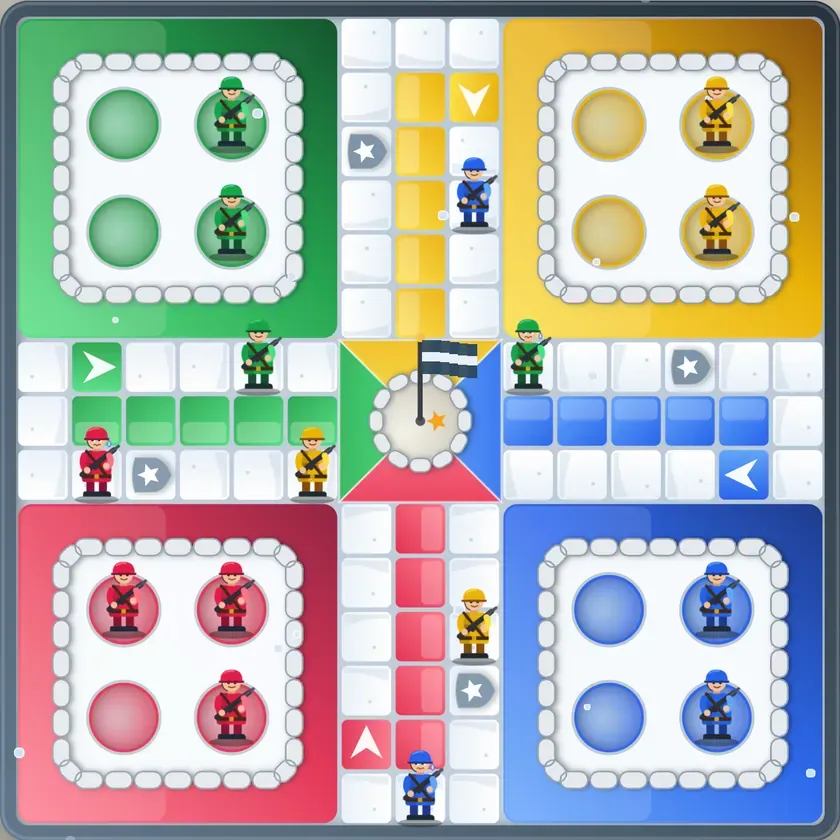
Under the most common Ludo rule, the third six in a row is not played and your turn ends straight away. Any moves you made with the first two sixes stay on the board. The next player rolls.
Wikipedia's Ludo article describes the same thing: if the third roll is also a six, the player may not move and the turn passes on. Families vary around it, but that is the version you are most likely to meet.
Step by step
Say you are playing Red and the die shows:
- A 6. You bring a piece out of the yard. You roll again.
- Another 6. You move that piece six squares. You roll again.
- A third 6. You do not move. The turn goes to the next player.
Your first two moves are real and they stand. Only the third roll is thrown away. You don't lose a piece or go backwards.
The rule exists to stop one lucky streak from swinging the whole game. Without it, a player could chain sixes indefinitely.
How often it actually happens
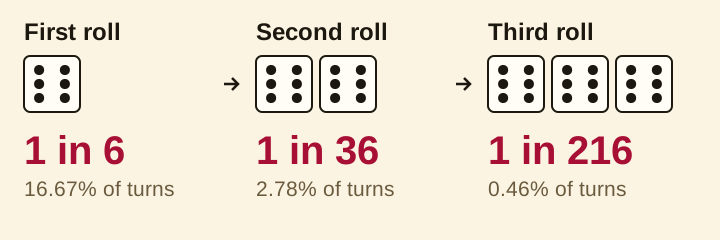
Less often than it feels like. Each roll of a fair die is independent, so three sixes in a row works out as:
1/6 × 1/6 × 1/6 = 1/216
That is 0.46%, or about one turn in every 216.
How often does that come up in a whole game? We ran 3,000 simulated four-player games with four pieces each under the classic rules, and counted. On average there were 1.67 forfeited turns per game across the whole table. About 81% of games had at least one. Any one player got hit at least once in about 34% of games.
So when it happens it isn't a sign the app has it in for you. It is the sort of thing that comes round once or twice a game if you count everyone at the table, and rarely lands on the player who is complaining about it twice. If you want the rest of the maths, there's a full guide to the odds of rolling a six.
The variations you will hear about
Three sixes is one of the most argued rules in Ludo, because everyone learned a slightly different version.
| Version | What happens on the third six |
|---|---|
| Common rule | The third six is thrown away. Earlier moves stand. |
| Harsher house rule | The whole turn is cancelled. Earlier moves are undone. |
| Parchís-style penalty | The last piece you moved is sent back to its nest. If it was on the final coloured ramp, it only drops to the bottom of that ramp. |
| No rule | Keep rolling and playing sixes for as long as they come. |
The penalty version comes from Parchís, a related Spanish game, as described on Wikipedia's Parchís page. That page gives no source of its own for the rule, so treat it as commonly reported. It is much harsher, and you should agree on it before the game starts rather than after someone has just rolled their third six.
The harsher house rule can get messy on a real board, because you need to remember where everything was. If your group wants it, do it on one die with the moves called out loud.
Does the rule change how you should play?
Slightly. If you have just rolled two sixes, the next roll is still 1 in 6 to be a six, and there's nothing you can do about that. The dice have no memory.
What you can control is how you spend the first two sixes. A six is the only number that brings a piece out of the yard under the usual rules, so a six spent getting a piece out is usually better than six squares on a piece that's already moving. Since a third six would be thrown away anyway, that first decision is the one that matters.
Don't play your second six differently out of fear of a third. The chance of a third six is the same either way, and your second move stands regardless.
How Ludo Fighters handles it
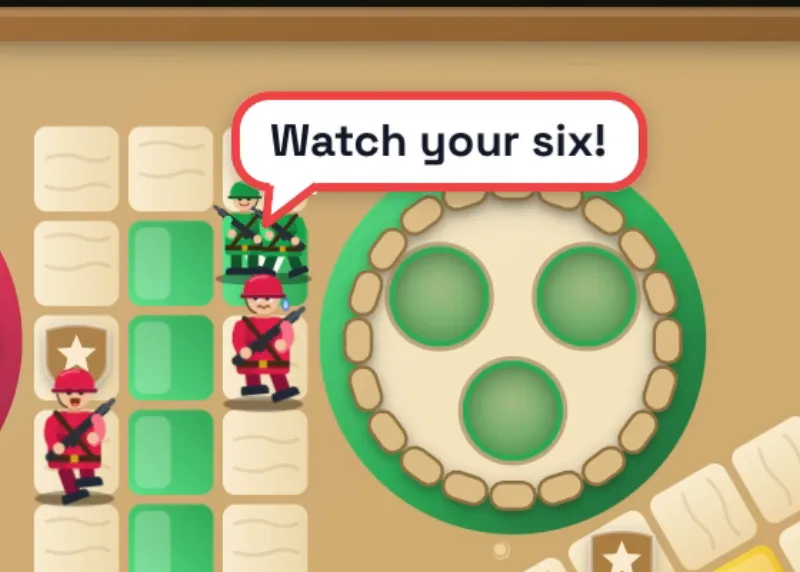
In Ludo Fighters the three-sixes forfeit is on by default. Roll a third six in a row and the game tells you the turn is forfeited, and play moves on. Your first two moves stand. In Custom match you can turn the rule off.
It's one of a set of house rules you can flip: six to leave base, extra turn on a 6, extra turn on a capture, exact roll home, safe squares, win when first or all home, and one die or two. With two dice the three-sixes count does not apply, because you move once per die and doubles give the bonus turn instead. The house rules guide goes through which ones are worth changing.
Common questions
Do you lose a piece if you roll three sixes?
Not under the common rule. The third six is thrown away and your turn ends. Only harsher house rules or Parchís-style rules send a piece back.
Do the first two sixes still count?
Yes, under the common rule. Moves made on the first and second sixes stay on the board.
Does the count reset if you get an extra turn for something else?
The count is of consecutive sixes in your turn. Roll anything other than a six and it resets to zero, even if you keep rolling because of a capture.
Is three sixes in a row rare?
Yes. It is 1 in 216 per turn, or 0.46%. It feels more common because it's memorable.
Sources
- Ludo, Wikipedia, for the common third-six rule.
- Parchís, Wikipedia, for the Parchís penalty.