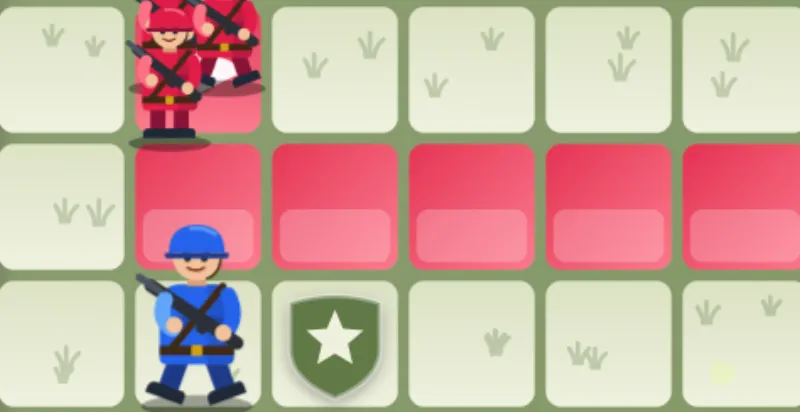
On a standard four-house Ludo board, eight squares are safe: the four coloured start squares and the four star squares. A piece standing on one cannot be captured. Your home column is safe too, because nobody else can enter it.
That is the short answer. The useful part is where those squares sit, because the spacing tells you what you can actually reach.
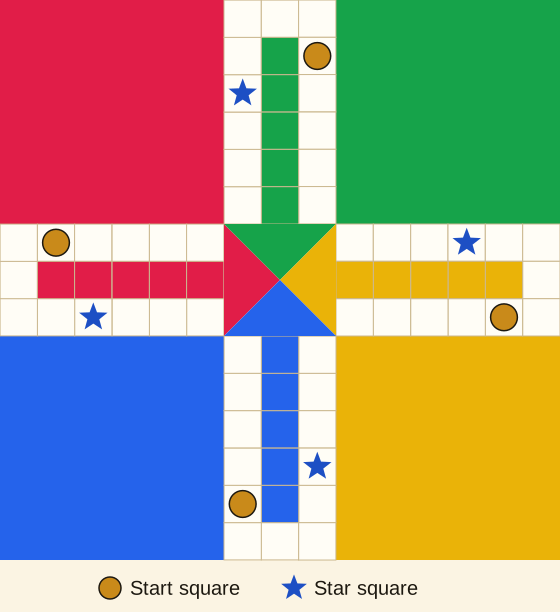
The spacing: 8, then 5, then 8, then 5
Count from your own start square as zero and walk clockwise. The safe squares come at 8, 13, 21, 26, 34, 39 and 47. After that, square 51 is the first square of your home column and nothing can touch you.
So safe squares alternate: eight apart, then five apart, all the way round. Two things follow.
- You can reach the next safe square in one roll only half the time. From a star, the next start square is 5 away, so a 5 lands you on it. From a start square, the next star is 8 away, and no single die gets you there.
- Your long gaps are the dangerous ones. The stretch after a start square is where pieces get hit, because you need at least two moves to cross it.
What safe actually means
A piece on a safe square cannot be sent home. If an opponent lands on that square, nothing happens and the two pieces share it. Moving past is always allowed. Safe squares protect the piece standing there and do not stop anyone else's movement.
Rules vary between families and countries, and not every old set has stars at all. Wikipedia's Ludo article notes boards with different safe markings in different places, including Danish boards with globe-marked spaces. If you are at someone else's table, ask before the first roll.
The classic full rule set is on our Ludo rules page. This guide stays on the one question.
How much a safe square is worth
A piece one to six squares in front of an enemy can be hit by one exact number. That is a 1 in 6 chance, 16.7%, from that one chaser on its next roll.
More chasers add up:
| Who is behind you | Numbers that hit you | Chance on the next roll |
|---|---|---|
| One enemy piece, 4 back | 4 | 1/6 = 16.7% |
| One colour, two pieces, 2 and 5 back | 2 or 5 | 2/6 = 33.3% |
| Two different colours, one piece each, both within 6 | one number each | 1 − (5/6)² = 30.6% |
| Three different colours, one piece each | one number each | 1 − (5/6)³ = 42.1% |
The two-colour row is lower than the same-colour row because each colour rolls separately. The working: you survive the first roll 5/6 of the time and the second 5/6 of the time, so you survive both with probability 25/36. One minus that is 30.6%.
A 6 also earns another roll under most rules, so the true number is a little higher. The table is the part you can do in your head.
Three ways to use them well
Stop short on purpose. If a roll puts your piece on a safe square, or leaves it just past one with enemies behind, take the safe square. A piece that has walked 40 squares is the most expensive thing on the board.
Don't park everyone. A safe square keeps a piece alive but gets it no closer to home. If all your pieces are sitting on stars, every roll forces you off one anyway, usually with a bad number. Keep one piece free to move.
Watch what the safe square is next to. A piece standing on a start square that belongs to someone else is safe, but the moment it steps forward it is right in front of any piece that colour brings out. If that player still has pieces in the yard, wait for a bigger number and jump clear.
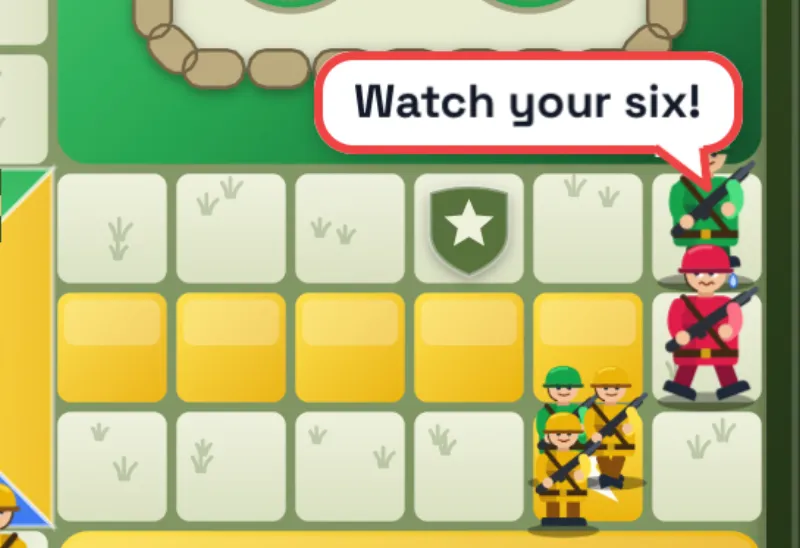
The idea is older than Ludo: Pachisi, the game Ludo descends from, has marked safe squares too. How Ludo, Parcheesi and Pachisi compare.
Safe squares in Ludo Fighters
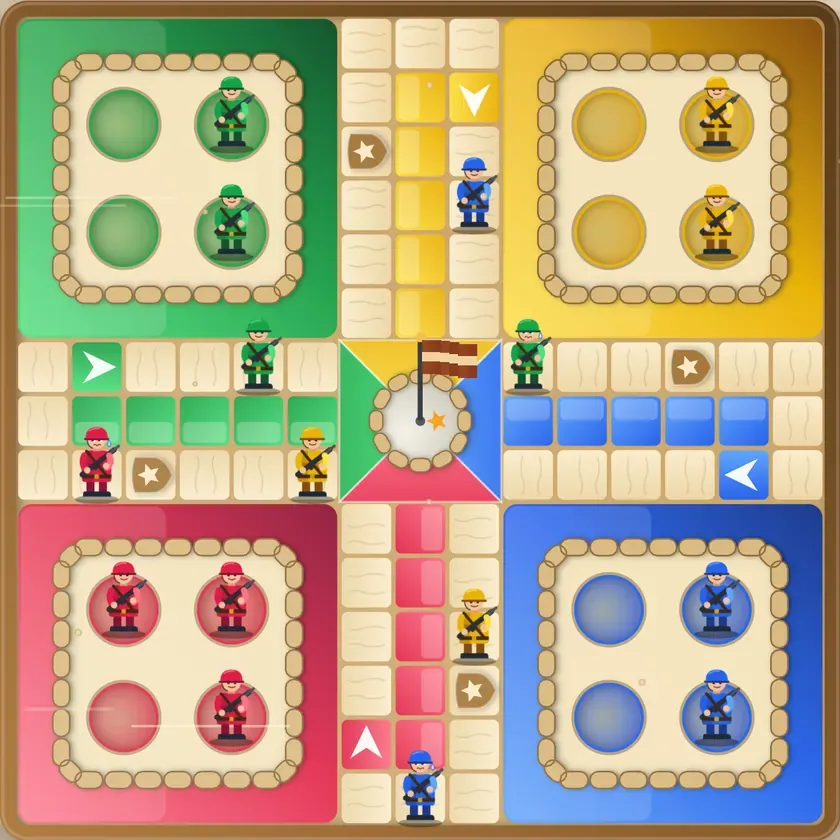
The game keeps the same eight squares on a four-house board and turns them into shield bunkers. Land on an enemy there and your soldier still opens fire, but the shot ricochets off a blue dome and nobody goes home. On the six-house board, used for five or six squads, there are twelve safe squares: one start and one star per arm. You can see that layout in the six-player guide.
Safe squares are also a switch in Custom match. Turn them off and the whole board is open, so no soldier is ever fully out of danger on the track. In our simulated games, turning them off raised captures from about 22 a game to about 37, and made games about a fifth longer. There is more on that in the house rules guide.
Common questions
Are all stars safe in Ludo?
On boards with star squares, yes. Check the set if it is old, because some printed boards have no safe squares at all except the start squares and home column.
Can two pieces of different colours sit on a safe square?
Yes. Nothing happens to either of them. Both stay put and both can leave on their next move.
Is the start square safe for everyone?
In the common rule set, yes: any colour can stand on any start square without being captured. A few tables play that a piece entering from the yard captures whatever is on its start square, so check first if you play with new people.
Can I capture a piece that is in its home column?
No. Home columns are private. Only that colour can enter, so anything inside is safe until it finishes.