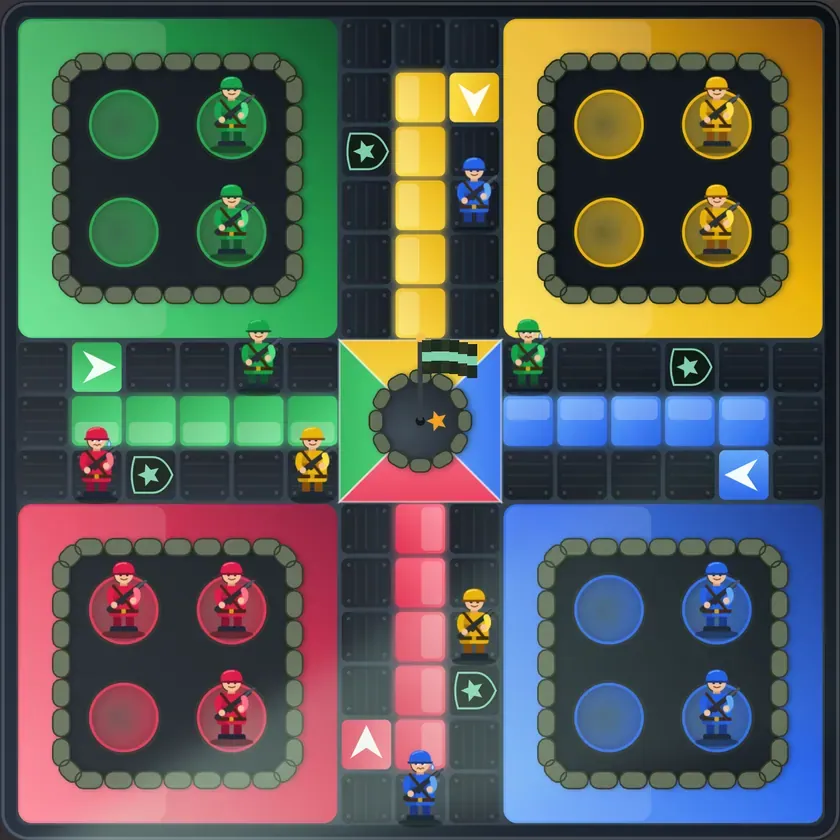
Two-player Ludo uses exactly the same rules as four-player Ludo. Each of you takes one colour and four tokens, and you still need a 6 to come out, an exact roll to get home and all four tokens home to win. The only choice that really matters is where you sit: take opposite corners.
Everything else follows from that. If you need the full rulebook, the classic Ludo rules are on their own page. This guide covers what is different with only two of you.
Pick opposite corners
Red against Yellow, or Green against Blue. Those pairs face each other across the board.
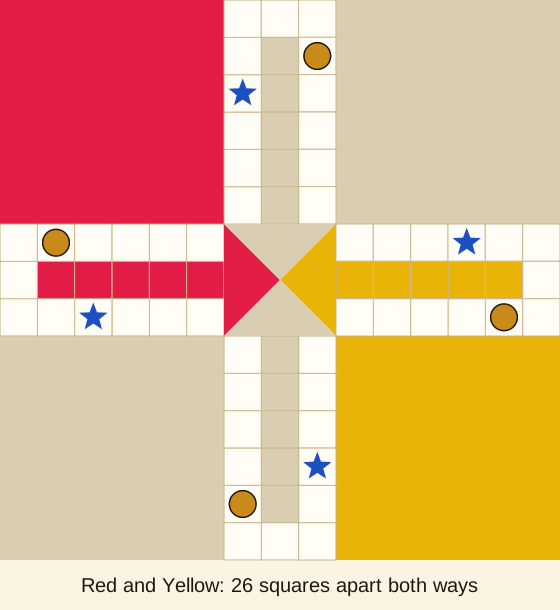
The board has a 52-square track, with the four start squares spaced 13 apart. Opposite corners give you 26 squares between start squares whichever way you count. Neither player has a positional edge.
Sit next to each other and it gets lopsided. One start square ends up 13 squares in front of the other, and 39 behind it going the rest of the way round. One player's pieces start life just in front of the other's guns, and the other player never has that problem.
Why captures almost vanish
This is the biggest change, and most people don't expect it. With two players there are far fewer pieces chasing you, and they spend most of their lap on the opposite side of the board.
We ran 2,500 simulated games at each player count, with every colour played by the same sensible strategy under classic rules:
| Players | Rolls per game | Rolls per player | Captures per game |
|---|---|---|---|
| 2 | 171 | 86 | 3.2 |
| 3 | 281 | 94 | 10.6 |
| 4 | 422 | 106 | 22.4 |
Going from four players to two doesn't just halve the captures. It cuts them to about a seventh, from 22.4 a game to 3.2. A two-player game is much closer to a straight race.
That's the whole strategic difference. In a four-player game you're always dodging. In a two-player game you can usually see the only threat on the board.
How to play a duel well
Get pieces out early. With so little fighting, the race is mostly about efficient use of rolls. Wasted rolls are what lose it. If you have only one piece on the board and it's near home needing an exact number, most of your rolls do nothing. Having two or three pieces out means nearly every roll is useful.
Count the one chaser. You only have one colour to watch. When your piece is in front of an enemy piece, count the gap. One to six squares is the danger zone, at a 1 in 6 chance per roll from each chasing piece. Seven squares or more is about six times safer. The odds guide shows the working.
Go hunting when you can afford it. Captures are rare, so each one is huge. A piece sent back has lost all its progress and needs a 6 to come out again. If your opponent's front runner is just ahead of you, it's often worth holding a piece back to chase it, instead of running your own lead home.
Watch the squares ahead of their start square. If your opponent still has pieces in the yard, a roll of 6 puts a fresh piece on its start square, right behind anything you have left on the next few squares. Don't dawdle there.
Should you play two colours each?
Some families do: each player takes two colours, usually opposite each other, and plays them as a team. It keeps the board busy and brings back the blocking and chasing of a four-player game, because you have eight pieces on the board and more decisions on every roll.
The downside is length. It's a full four-colour game with all the pieces, only with two people making the decisions. If you want a quick duel, one colour each is the right choice. If you want a long game for the evening, try two colours each. Decide whether the winner is the first colour home or the first player with both colours home before you start.
Two players in Ludo Fighters
You have three ways to play a duel.
- Pass & play on one phone. It sets up two players on opposite corners, the board stays flat on the table, and the far player's dice face them.
- Custom match lets you switch on any two squads, or add Lumi AI to fill the empty seats if you want more going on.
- Online squads has Quick battle for 2 players, or a private room with a 6-character code. How room codes work has the details.
Whichever you pick, the rules above still apply: you can set them in Custom match or a private room, with three sixes forfeit, exact roll home and the rest. A capture is a gun fight rather than a piece being lifted off the board.
Common questions
Can 2 people play Ludo?
Yes. Ludo works with two, three or four players on a standard board.
Which colours should two players use?
Opposite corners: Red and Yellow, or Green and Blue. Adjacent corners give one player a positional edge.
Do the rules change with 2 players?
No. Same 52-square track, same need for a 6, same exact roll home. Only the seating and the feel of the game change.
How long is a 2-player Ludo game?
In our simulations a 2-player game with four tokens each took about 171 rolls in total, around 86 each. Real games vary with how you play and the rules you use.