The house rules that change Ludo the most are the ones that shorten it: play with fewer pieces, end the game when the first piece gets home, or roll two dice. Each of those cuts a four-player game by more than half. Most of the rules people argue about at the table barely change the length at all.
We know because we tested them. Each rule below was simulated over 2,500 four-player games, with every side playing sensibly and four pieces each unless stated.
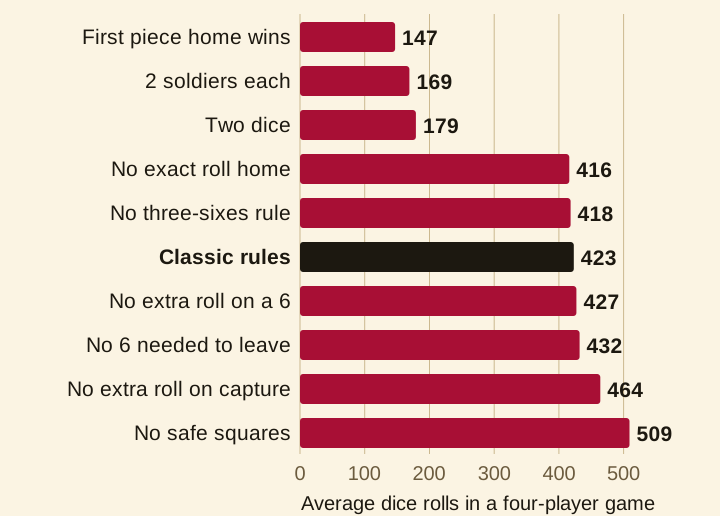
| Rule change | Rolls per game | Captures per game |
|---|---|---|
| First piece home wins | 147 | 6.9 |
| 2 soldiers each | 169 | 4.9 |
| Two dice | 179 | 17.0 |
| No exact roll home | 416 | 22.4 |
| No three-sixes rule | 418 | 22.3 |
| Classic rules | 423 | 22.4 |
| No extra roll on a 6 | 427 | 22.4 |
| No 6 needed to leave the yard | 432 | 33.1 |
| No extra roll on a capture | 464 | 27.4 |
| No safe squares | 509 | 37.3 |
The classic rules are on our Ludo rules page. Here is what each change really does.
The three that make it shorter
First piece home wins. The biggest cut, from 423 rolls to 147. It removes the long end of the game, where most of your pieces are home and you're waiting on one exact number. It also changes the strategy, since all you need is one good runner. Good for a quick round, or a warm-up before the real game.
Fewer pieces. Two soldiers each brings it down to 169. Unlike first-home-wins, you still have a real decision on most rolls, because you've got two pieces to choose between. This is the one we'd pick if you only change one thing.
Two dice. Down to 179 rolls, and you move once per die. It's the most interesting of the three because you are making two decisions each turn, and captures stay high at 17 a game. If you want a faster game that still feels like a fight, start here.
The ones that don't do what you'd think
Dropping the 6 to leave the yard. Everybody assumes this speeds the game up. In our test it didn't: 432 rolls against 423. Pieces come out sooner, but the board gets crowded and captures rise by half, to 33.1 a game, so everyone gets sent back more often.
What it does fix is boredom. Under classic rules, 13.8% of all rolls did nothing at all, mostly from waiting for a 6. Without the rule, that fell to 1.1%. So drop it if people at your table are bored, not if they are short of time.
The three-sixes rule. Removing it changes nothing we could measure: 418 rolls against 423. It only comes up about 1.67 times a game. Play whichever version stops the argument.
Exact roll home. Dropping it moves the game from 423 rolls to 416. That is close to nothing. The exact roll feels like it costs a lot because you remember every wasted turn, but it doesn't change much overall. Keep it if you like the tension at the end.
No extra roll on a 6. Almost no difference to total length, at 427 rolls. Turns get shorter, though, so the table moves faster and nobody goes on a run.
The ones that make it longer and meaner
No extra roll on a capture. Slower, at 464 rolls, and it takes away the reward that makes attacking worth it. We wouldn't bother.
No safe squares. The longest game here at 509 rolls, and the one with the most captures: 37.3 against 22.4. Every piece is exposed the whole way round. Great for a group that enjoys being cruel to each other, and a poor choice for anyone who sulks. What safe squares do explains what you're giving up.
Recipes
Short game. Two soldiers each, one die, everything else classic.
Quick and busy. Two dice with four soldiers each. Plenty of fights, and fast enough for a weeknight.
Family table with small kids. On a printed board, drop the 6 to leave. Nobody spends the start of the game doing nothing.
The long grudge match. Four or more soldiers each, no safe squares. Clear the evening.
Whatever you choose, agree it before the first roll and say it out loud. Most Ludo fights are really two people playing two different rule sets.
Why Ludo can feel boring, and what rules can't fix
The complaints are usually the same three: waiting for a 6, waiting for an exact number at the end, and a capture that amounts to someone lifting a token off the board. House rules fix the first two. The third is about what a capture feels like.
That's where battle Ludo comes in. In Ludo Fighters every capture is a short cartoon gun fight, with a pistol, rifle, shotgun, sniper or grenade, then the knocked-out soldier respawns at base. Same rules, more of a moment.
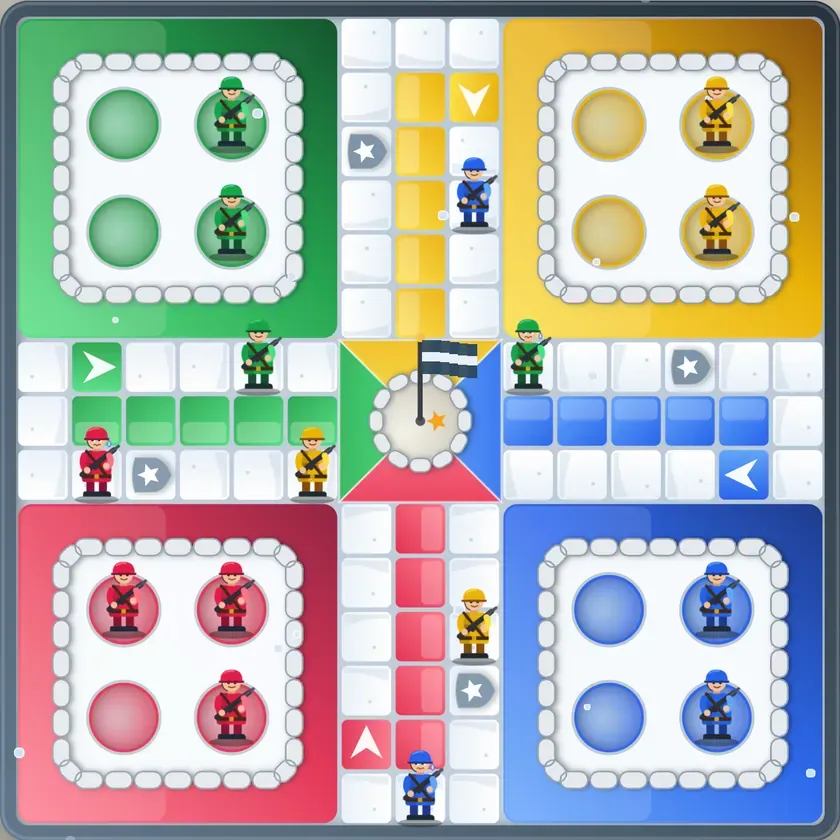
Want to go further than house rules? Build your own Ludo rules with landmines, chaos cards and shareable codes.
All of these are switches in Ludo Fighters' Custom match, and hosts can set them in a private room too: six to leave base, extra turn on a 6, extra turn on a capture, three sixes forfeit, exact roll home, safe squares, win when first or all home, and one die or two, with 1 to 6 soldiers per squad.
Common questions
What are the best house rules for Ludo?
For a shorter game, two soldiers each or two dice. For less waiting around, drop the need for a 6. For a meaner game, turn off safe squares.
How do you make Ludo more interesting?
Give players more decisions: two dice or more pieces. Or raise the stakes by turning off safe squares.
Does removing the need for a 6 make Ludo faster?
Not in our simulation. It took 432 rolls against 423 for classic rules, because more pieces on the board mean more captures. It does cut wasted rolls from 13.8% to 1.1%.