To win at Ludo, follow this order every roll: capture if you can, finish a piece if you can, bring out a new piece on a 6, then make the move that leaves the fewest pieces in danger. That checklist won 80.8% of four-player games against three players moving at random in our simulation, where a fair share would be 25%.
You can't control the dice. You can control which piece moves, and that one decision adds up fast.
We tested the usual advice
Most Ludo tips are stated as facts and never checked. So we built a simulator following the classic rules (a 6 to leave the yard, extra roll on a 6 and on a capture, three sixes forfeit, exact roll home, eight safe squares) and played one strategy against three opponents, over tens of thousands of games.
| Strategy | Win rate vs 3 random players | Win rate vs 3 Rookie Lumi AI |
|---|---|---|
| Moving at random | 25.0% | 10.3% |
| Always move your front piece | 37.3% | 21.9% |
| Capture if you can, otherwise random | 38.9% | not tested |
| The checklist below | 80.8% | 63.8% |
A fair share in a four-player game is 25%. Results are within about one percentage point either way, and the first column is from 40,000 games per row, the second from 10,000.
Random opponents are not real people, so don't read 80.8% as your win rate at the family table. Read the gaps. Capturing alone adds very little. Running your best piece alone adds very little. Doing the right thing in the right order doubles the result.
The checklist, in order
1. Capture if you can. A piece sent home loses all its progress and needs a 6 to return. If two captures are possible, take the one furthest along. Capturing also earns another roll under most rules.
2. Bring a piece home if the roll does it. An exact roll is hard to get. Don't pass one up for a nicer move elsewhere.
3. On a 6, bring out a new piece. More pieces on the board means more choices on every later roll, and more chances to use an awkward number. This is the step most casual players skip, usually because they want to run with the piece they already have.
4. Get out of danger, or don't step into it. Look at each legal move and count how many enemies could hit that piece afterwards. Pick the move that lowers that count the most. Landing on a safe square is usually the best version of this.
5. If nothing else applies, advance your front piece. At this point the roll isn't doing anything clever, so take the progress.
That's the whole method. It doesn't need any memorising beyond the order.
How to read danger
The most useful number in Ludo is how far an enemy is behind you.
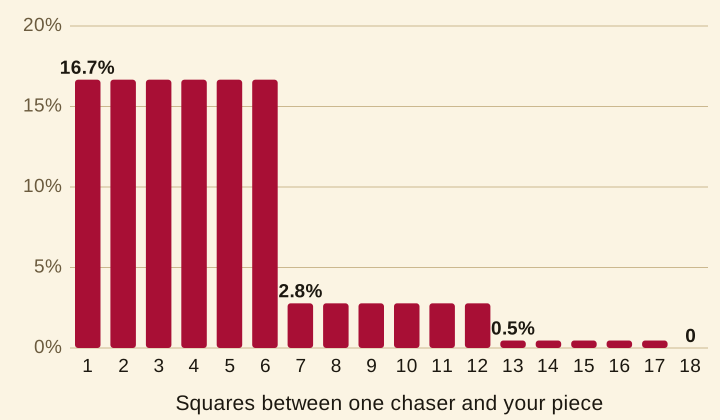
From one to six squares behind you, a chaser hits on one exact number: 1 in 6. At seven squares it needs a 6 and then a 1, which is 1 in 36. So there's a cliff at seven squares, where you become about six times safer. The odds guide has the full working.
Two practical habits come out of that:
- Count back six. Before you finish a move, count six squares behind where you will land. Any enemy piece in that range can hit you.
- Two chasers are worse than one. Two pieces of one colour at different distances hit on two numbers, so 2 in 6. Two different colours get a roll each: that's 30.6%, nearly the same.
Don't run one piece home
The classic beginner strategy is to take one piece and sprint. It feels productive, and it's the "always move your front piece" row in the table: 37.3%, far behind the checklist's 80.8%.
The problem is that a single runner has no options. You roll a 3 and the only move is one that puts it right in front of an enemy. With three or four pieces out, you nearly always have somewhere better to spend that 3.
The endgame
When most of your pieces are home, you lose your freedom of choice. A piece that needs an exact 2 will wait a long time, because each roll has only a 1 in 6 chance. Two things help:
- Don't bring the last two home together. Keep them a few squares apart so they need different numbers. Needing either a 2 or a 5 comes up twice as often as needing a single number.
- Keep one piece on the track if you can. A roll that can't finish a piece can still move something useful.
Against real people
The checklist is a baseline. Good players add a read of who is at the table.
Don't threaten the player who's far behind if the leader is close to winning. Go after the leader's front piece instead. And at a real table, people forget: they leave pieces in danger and don't notice a capture on offer. Count squares out loud in your head and you'll be ahead of most of them.
If you want to practise, a capture in Ludo Fighters is a short gun fight rather than a piece being moved off the board, and you can try the checklist against different Lumi AI personalities. Beating the computer has the numbers for each.
Common questions
Is there a trick to always win at Ludo?
No. The dice decide a lot, and no strategy wins every game. A good move-order wins far more often than bad or random play, but it doesn't guarantee anything in a single game.
Should I bring out a new piece or move one that's already out?
Bring out a new piece on a 6 unless you have a capture or an exact roll home available. More pieces mean more options later.
Should I always capture in Ludo?
Nearly always, and when two captures are available, take the piece that has come furthest.
Does going first help in Ludo?
Barely. In 60,000 simulated games with random moves, the first player won 25.4% of four-player games, against a fair share of 25%, and 51.1% of two-player games. There's more on that in is Ludo luck or skill.