A fair die shows a six 1 time in 6, which is 16.7%. On average that means one six every six rolls, but you can easily wait much longer than that. There is roughly a 1 in 6 chance of rolling ten times with no six at all.
The odds are fixed and simple. What people get wrong is how long the unlucky streaks really are.
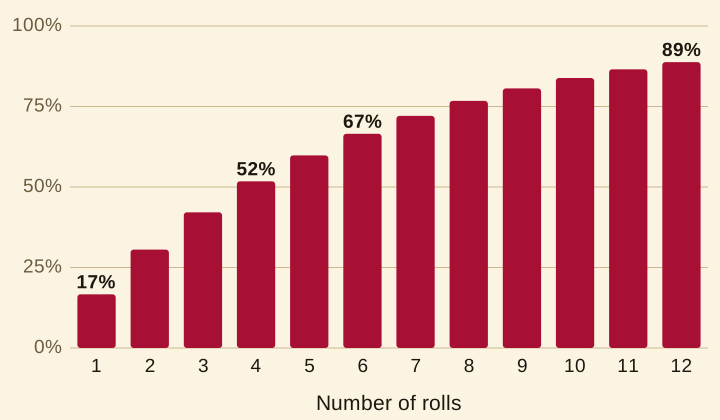
The chance of at least one six
Work out the chance of not rolling a six, then subtract from 1. Each roll misses with probability 5/6, and rolls don't affect each other, so n misses in a row is (5/6)ⁿ.
| Rolls | No six in any of them | At least one six |
|---|---|---|
| 1 | (5/6)¹ = 83.3% | 16.7% |
| 2 | (5/6)² = 69.4% | 30.6% |
| 3 | 57.9% | 42.1% |
| 4 | 48.2% | 51.8% |
| 6 | 33.5% | 66.5% |
| 8 | 23.3% | 76.7% |
| 10 | 16.2% | 83.8% |
| 12 | 11.2% | 88.8% |
| 20 | 2.6% | 97.4% |
Two numbers worth remembering:
- Four rolls is your coin flip. You need four rolls before a six is more likely than not, at 51.8%.
- Six rolls does not mean a six. After six rolls you still have a one in three chance of nothing, at 33.5%.
Why waiting in the yard feels so bad
If you need a six to leave your yard, you spend real time doing nothing at the start of a game, and that is the part everyone remembers.
The average wait for one six is 6 rolls. That number comes from a neat bit of probability: for something with chance p, the expected number of tries is 1/p, and 1/(1/6) = 6. To bring all four pieces out you need four sixes, so 24 rolls of your own on average, spread through the game.
In a table of four people, one of you will have a bad start most of the time. If each player rolls six times, the chance that a given player gets no six is 33.5%. The chance that at least one of the four gets none is 1 − (1 − 0.335)⁴, which comes out at about 80%. Someone at the table is very likely to be stuck, and it doesn't mean anything about the dice.
The dice have no memory
The most common mistake in dice games: "I haven't rolled a six in ages, one must be due." The die doesn't know. After nine rolls with no six, the chance of a six on the tenth is still 1/6.
The same applies the other way. Rolling two sixes doesn't make a third any less likely on that roll. The reason three sixes in a row is rare is that it needs all three at once. It says nothing about each one. There's more on that in what happens when you roll three sixes.
In Ludo Fighters every roll is an independent roll of a fair die. Lumi AI rolls the same dice you do, and in Online squads the server rolls for everyone.
What the numbers mean on the board
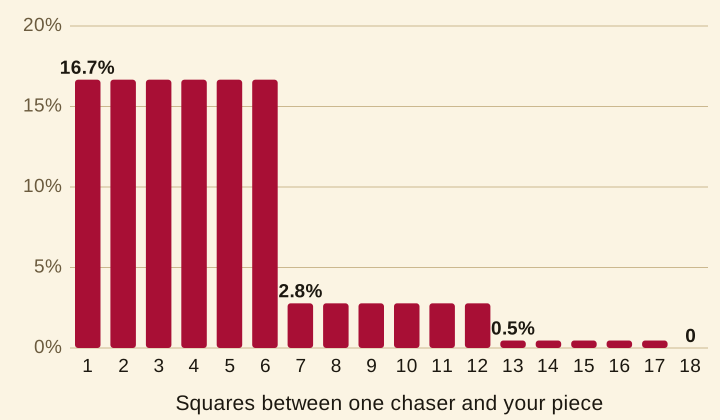
The odds you actually use during a game are about capture. Here is the chance that one specific enemy piece hits you on its next turn, by how many squares it is behind you.
The working:
- 1 to 6 squares back: it needs one exact number. 1/6 = 16.7%.
- 7 to 12 squares back: it needs a 6, then the rest. 1/6 × 1/6 = 1/36 = 2.8%.
- 13 to 17 squares back: it needs 6, 6, then the rest. 1/216 = 0.5%.
- 18 squares back: three sixes, and the third is forfeited. Zero.
There is a cliff at seven squares. Being seven in front of a chaser is about six times safer than being six in front of it. That single fact is why good players care about distance and not just about squares. The strategy guide builds on it.
With two dice
Some people play Ludo with two dice, moving once per die. The chances change like this:
- At least one six: 1 − (5/6)² = 11/36 = 30.6%.
- Both sixes: 1/36 = 2.8%.
- Doubles of any kind: 6/36 = 16.7%.
So two dice nearly double your chance of a six each turn. Custom match in Ludo Fighters has it as a setting, with doubles earning a bonus turn.
Common questions
What are the odds of rolling a 6 on a die?
1 in 6, or 16.7%, on any single roll of a fair six-sided die.
How many times do you need to roll to get a six?
On average 6 rolls. There is a 51.8% chance of at least one six within 4 rolls, and 88.8% within 12. No number of rolls is guaranteed.
Is it harder to roll a six than other numbers?
No. Every face of a fair die has the same 1 in 6 chance. It feels harder because a six is usually the only number you want.
Are the dice in Ludo apps rigged?
We can only speak for Ludo Fighters, where dice are fair: each roll is independent and Lumi AI gets the same dice as you.