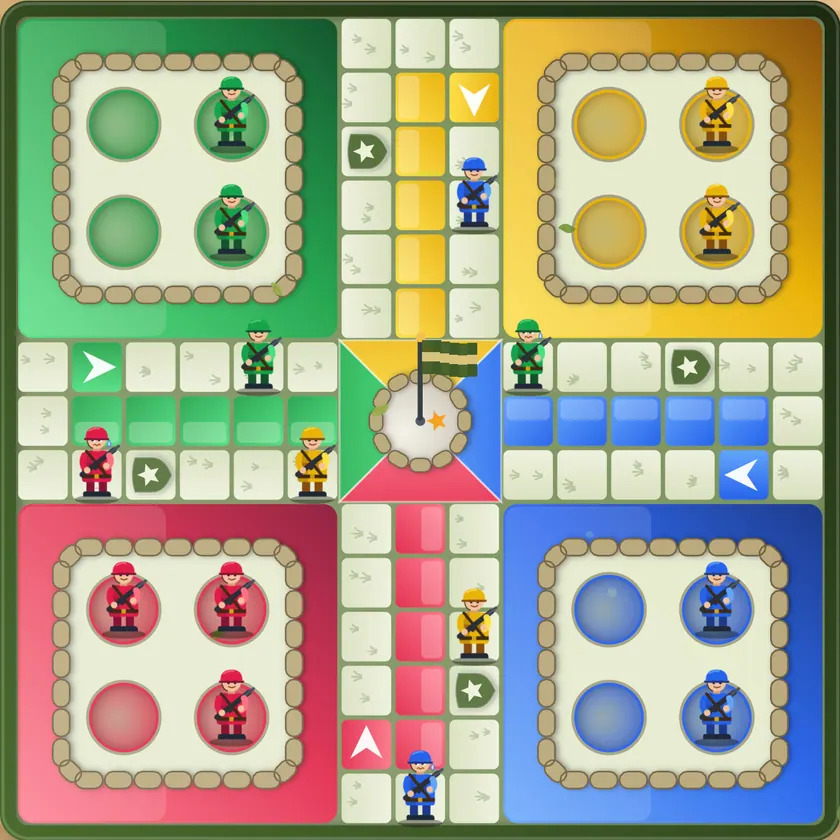
Ludo and Parcheesi are both simplified descendants of Pachisi, an old cross-and-circle race game from India. Pachisi uses cowrie shells instead of dice and is usually played in teams. Parcheesi, the American branch, uses two dice and adds blockades. Ludo, the British branch, cut it down to one die and a simple race.
The rules are easy to compare. The history is less tidy, and we'll be clear about where the sources disagree.
The three games side by side
| Feature | Pachisi | Parcheesi | Ludo |
|---|---|---|---|
| Dice | Six or seven cowrie shells | Two dice | One die |
| Getting a piece in | Pieces begin from the central square | A 5, on one die or as the total | A 6 |
| Players | 2 to 4, four usually play as two teams | Four pieces per player | 2 to 4, no partnerships |
| Extra turns | Certain throws, depending on the shells | Doubles give extra moves | Rolling a 6 |
| Bonus for a capture | Not covered by our sources | A free 20-square move | Depends on the table |
| Blocking | Castle squares protect pieces | Two pieces on a square form a blockade | A house rule, where it's played at all |
Sources: Pachisi, Parcheesi and Ludo on Wikipedia, which cite the published rules and game histories.
Pachisi's shells make a very different kind of game. With six cowries, a throw is scored by how the shells land: results of 2 to 5 count at face value, while a result of 0 scores 25 and a result of 1 scores 10. The biggest throw is 25. The name comes from that: Pachisi comes from the Hindi word paccīs, meaning twenty-five.
The board is bigger too. Each of the cross's four arms is three columns wide and eight squares long, with a central square called the Charkoni where pieces start and finish. A Ludo arm is six squares long, on a 15 by 15 grid.
Where Pachisi came from
Pachisi comes from India, but nobody can pin down when. Different sources give different answers. The Traditional Games site says uncertain evidence puts forms of the game in the region from at least the 4th century AD. Others say the 6th century. Wikipedia itself calls it both ancient and medieval. A date to within a few hundred years is the honest level of precision.
The best-known story is about scale. Accounts from the 1800s describe the Mughal emperor Akbar playing the game on an enormous court laid out in the palace grounds, with people as the pieces. A large stone court survives at Fatehpur Sikri, and the Pachisi article on Wikipedia cites Falkener's 1892 book, which quotes the traveller Louis Rousselet on it. Treat it as a good story from a 19th century travel writer, not as a court record.
How Ludo reached England
Ludo is the game Victorian England made from Pachisi, with a square board, a single die and no teams. The name is simply Latin for "I play", as Jaques of London points out.
The date needs some care.
- Wikipedia, citing R. C. Bell's Board and Table Games From Many Civilizations, says the game was marketed as Ludo in England in 1896 by Alfred Collier, who patented it as "Royal Ludo" under number 14636.
- The Traditional Games site also gives 1896.
- Jaques of London says the name was registered to them in 1896 and credits itself with bringing the game to Britain.
- The Madras Courier says Collier applied in August 1891 and patent 14636 was granted that October.
So 1896 is the date you will see most often, but an 1891 patent has been reported, and the patent and the "Ludo" name may not be the same event. We could not check the original patent record. If you need the exact year for something important, go and find it in the UK patent archives, not on a website, including this one.
How Parcheesi became American
Parcheesi is a brand-name American version of the same game. The Traditional Games site says John Hamilton of the Hudson River Valley claimed copyright in 1867, and the game later passed to Selchow & Righter, who trademarked it in 1874. Another detailed history of the game says Parcheesi's early American history is "shrouded in fog and uncertainty" and lists conflicting dates. Its chain runs through Albert Swift and E.G. Selchow & Co before the 1874 trademark. That page also calls the Sam Loyd invention story very doubtful.
The rule that stayed most distinctive is the blockade. Two pieces of one colour on a square can't be passed by anyone, as the published rules describe it. That single rule makes Parcheesi a noticeably different game: you can trap an opponent behind a wall.
What Ludo dropped, and what that did
Ludo got rid of the cowrie maths, the teams and the blockade. What was left was simple enough for a child to pick up in a minute, and that is probably why it travelled so well.
It also left the game very dependent on the die. Which is why the argument about how much Ludo is luck or skill has never really stopped. It is also why people keep reaching for house rules to put back some of what the Victorians took out.
Same family, one more branch
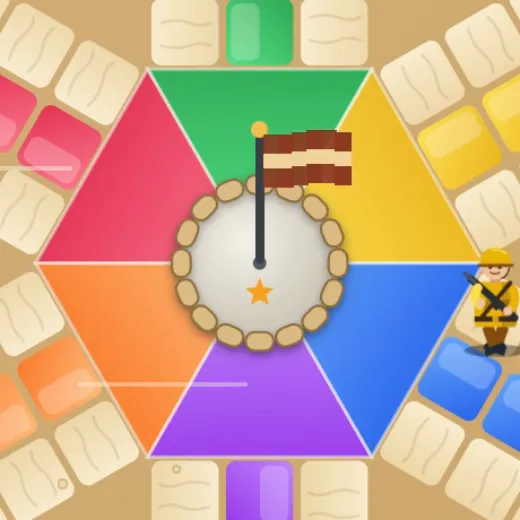
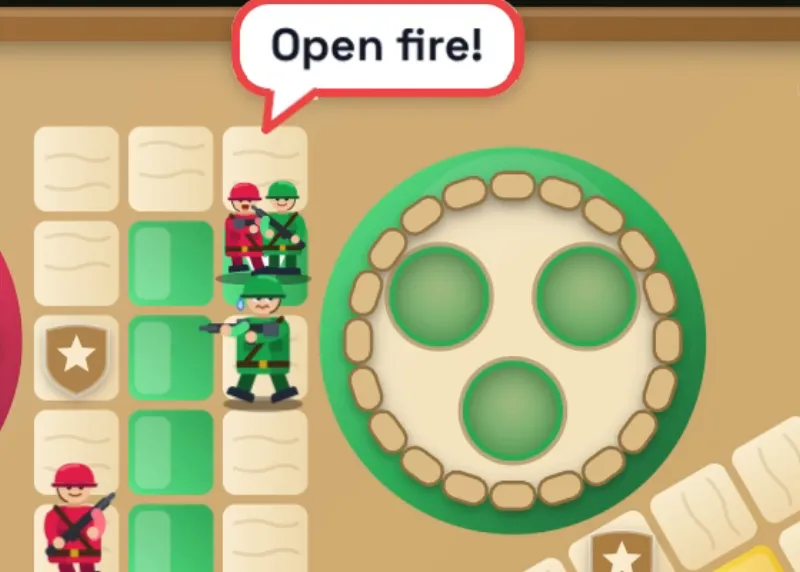
Ludo Fighters is a modern branch of the same tree. On a four-house board it keeps the Ludo rules: a 52-square track, a 6 to leave base, a capture by landing exactly on an enemy. What it changes is what a capture looks like, because every piece is a soldier and every capture is a cartoon gun fight. If you're after the classic version first, read how classic Ludo is played.
Sources
- Pachisi, Parcheesi and Ludo, Wikipedia, for the rules and for citations to Bell (1979), Falkener (1892) and Finkel (2004).
- Pachisi, Traditional Games, for dating and the 1867 to 1874 Parcheesi timeline.
- Parcheesi history at pachisi.vegard2.net, for the disputed early American record.
- How Pachisi became Ludo, Madras Courier, for the 1891 patent dates.
- History of Ludo, Jaques of London, for the 1896 registration and the meaning of the name.