Ludo is both luck and skill. In a single game, luck can beat anyone. Over many games, the player making better choices wins far more often, so skill is real but it needs time to show.
The dice decide which moves you're allowed. You decide which piece makes them. That choice comes up on nearly every roll once you have more than one piece out.
What we measured
We ran simulated four-player games under the classic rules: a 6 to leave the yard, extra roll on a 6 or a capture, three sixes forfeit, exact roll home, eight safe squares. One player used a given strategy against three identical opponents. If skill didn't matter, everyone would win 25% of the time.
| Player | vs 3 random players | vs 3 Rookie Lumi AI | vs 3 Strategist Lumi AI |
|---|---|---|---|
| Random moves | 25.0% | 10.3% | 1.1% |
| Rookie Lumi AI | 49.5% | same strength | 3.1% |
| Simple checklist | 80.8% | 63.8% | 21.5% |
| Strategist Lumi AI | 82.8% | 67.1% | same strength |
Results are within about one percentage point. Two readings matter.
Skill matters a lot. A sensible move order takes you from a 25% share to 80.8% against random players, and to 92.1% in a two-player game. And it cuts the other way too: a player moving at random won only 1.1% of games against three Strategists. If Ludo were only luck, that number would be 25%.
Luck never goes away. Even the strongest strategy here still lost about one game in six to three opponents moving at random. And once everyone at the table plays sensibly, most of the difference disappears. Our checklist scored 21.5% against three Strategists, close to a fair share, even though Strategist weighs the whole board and the checklist is five plain rules. Between decent players, the dice decide most games.
Why one game tells you nothing
The gap between good players is small, and small gaps take a lot of games to see. Say you really are a bit better than your friends and win 30% of four-player games instead of 25%. The margin of error on a win rate after n games is about 1.96 × √(0.25 × 0.75 / n). To get that down to five percentage points, you need about 288 games.
That's why arguing about who's better after one game is pointless. Against people close to your own level, you'd need hundreds of games to prove anything.
Where skill actually lives
A roll gives you one number, and usually several ways to use it. Good decisions come down to a few things:
- Using sixes to bring pieces out, so later rolls have more options.
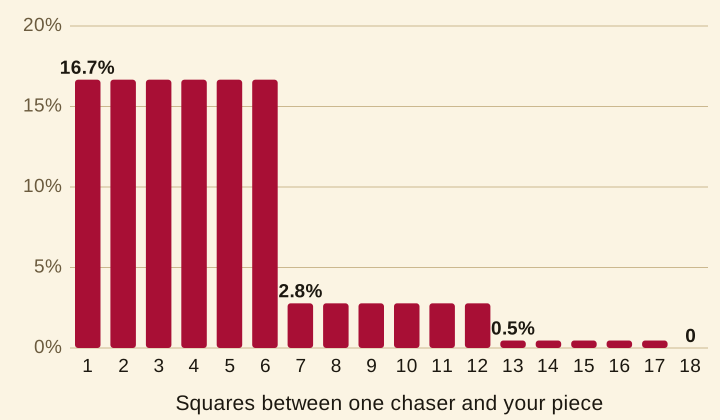
- Reading the danger range. One to six squares ahead of an enemy is a 1 in 6 risk from that piece. Seven is 1 in 36. The odds guide shows why.
- Taking captures at the right time, especially the most advanced enemy piece.
- Using safe squares without parking everything on them.
The five-step checklist puts those in order.
And luck lives in the parts you can't touch: when your first 6 arrives, whether an enemy rolls the one number it needed, and whether your last piece gets its exact roll.
Does going first matter?
Barely. In 60,000 simulated games with random moves, the first player won 25.4% of four-player games, against a fair share of 25%, and 51.1% of two-player games. The two-player edge is small but real. The four-player edge is hard to tell from no edge at all, since the margin of error is about 0.35 points.
What researchers found
We're not the only ones who have tried to measure this. A 2024 paper, Skill vs. Chance Quantification for Popular Card & Board Games by Banerjee, De, Maitra and Mukherjee, looked at how player win rates improve with experience across Chess, Rummy, Ludo and Teen Patti. It ranked Chess highest for skill and Teen Patti lowest, with Rummy and Ludo in between. Their method and ours are completely different, and theirs uses real players, but the conclusion points the same way: Ludo has a skill component and it isn't chess.
How to tilt the odds
If you want more decisions in your games, the rules help. Two dice give you two moves to plan each turn, and more pieces mean more choices on every roll. The house rules guide shows what each rule does to game length.
Ludo Fighters lets you set all of that in Custom match, and Lumi AI gives you opponents of a known strength to measure yourself against. Lose to Commander a few times and you'll know how much of your record was the dice.
Common questions
Is Ludo a game of skill or chance?
Both. Dice add chance on every roll, while which piece you move is a skill decision. Over many games the skilled player wins far more often.
Can a beginner beat a good Ludo player?
Yes, in a single game, because the dice can swing it. Over many games, a good player will win clearly more often.
Does strategy matter in Ludo?
Yes. In our simulations, following a simple move order won four games in five against random play.
Sources
- Banerjee, De, Maitra and Mukherjee, Skill vs. Chance Quantification for Popular Card & Board Games, arXiv, 2024.
- Simulations: our own, run on the game's default rules and Lumi AI's move-choosing code.